Do You Want Report Medical Errors to Family
Most people give little or no thought to medical errors in their daily lives. Unless you have actually been affected by a medical mistake, the possibility that it could happen to you probably seems fairly far-fetched. But is it?
We take a look at medical errors, their causes, and what, if anything, can be done nearly them.
Summit Health Statistics
- Medical billing errors cost Americans $210,000,000,000 annually.
- Roughly 12,000,000 Americans are misdiagnosed each year.
- Medical errors cause an estimated 250,000 deaths in the The states annually.
- As many equally 80 percent of medical bills contain at least one error.
- A little more than 4,000 surgical errors occur each year.
- It'due south estimated that seven,000 to 9,000 patients die every year from medication errors.
Every bit you can run into from our elevation stats, medical errors are abundant in the American wellness care system. What qualifies equally a medical fault, and how tin you know if y'all or a loved one has been the victim of ane?
What Is a "Medical Mistake"?
According to the book Medical Error, it is divers every bit a "preventable agin effect of medical care, whether or not it is evident or harmful to the patient." (Accent added.)
As a patient, you may non fifty-fifty know a medical error has taken place, and even if you practise know about it, the medical error may not negatively affect yous in any fashion. However, many medical errors are quite serious, and can even result in decease.
According to data provided by the U.S. Department of Health and Human Services, i in seven patients on Medicare in a hospital setting is the victim of a medical fault.
A Johns Hopkins report released in 2016 estimated that roughly 250,000 people die annually because of medical errors. That would make medical errors the third leading cause of death in the The states, behind only center illness and cancer.
Tiptop Ten Causes of Death in the United States (2016)
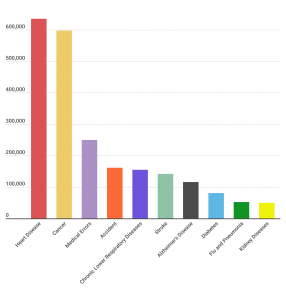
*It should be noted that the annual death rate from medical errors is an extrapolation based on a smaller puddle of information.
Equally you lot tin see from the chart in a higher place, eye disease and cancer each kill roughly 600,000 Americans per year. They are followed past medical errors, then accidents at 161,000 deaths per year.
Some studies point that death from medical errors could be even college due to the way medical errors are reported on death certificates—with as many equally 440,000 people dying every year from medical errors. The number of deaths caused by medical errors is far too high.
Loftier-Risk Medical Errors
Sometimes, a medical error poses footling concrete hazard to a patient, such every bit getting billed for a procedure that didn't take place.
Other times, the consequences are life or death—and those types of high-risk medical errors typically occur in fast-paced, loftier-pressure level environments, such equally hospital emergency rooms, infirmary intensive intendance units, and operating rooms in hospitals.
But that doesn't mean medical errors can't happen at your care provider's office or other outpatient settings.
Types of Medical Errors
Now that nosotros've divers what counts as a medical error, what are the well-nigh common types of medical errors in the United States?
- Misdiagnosis
- Billing errors
- Incorrect medication/incorrect dosage
- Incorrectly identifying a patient
- Surgical errors
Nosotros explore each type of error in more item below.
Misdiagnosis
Misdiagnosis occurs when a patient with one illness or disease is told they accept a dissimilar illness or disease. Co-ordinate to a 2014 study, roughly 12,000,000 Americans are misdiagnosed at outpatient facilities every year.
The written report'due south authors concluded that this issue creates a "substantial patient safety risk" and should be addressed. Reducing the take a chance of patient harm should be a main priority.
Of the 12,000,000 total Americans receiving a misdiagnosis, roughly 50 percent could be seriously harmed by getting the wrong diagnosis, as shown in the chart below.
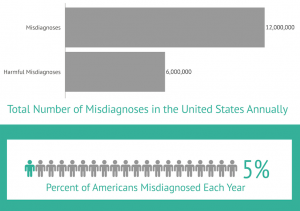
That full number breaks down to about 5 percentage of the adult U.S. population.
According to a written report that analyzed more than 300 medical claims between 2007 and 2013, the following health issues were the virtually usually misdiagnosed.
- Stroke
- Center set on
- Spinal epidural abscess
- Pulmonary embolism
- Necrotizing fasciitis
- Meningitis
- Testicular torsion
- Subarachnoid hemorrhage
- Septicemia
- Lung cancer
- Fractures
- Appendicitis
Some of these may not sound very familiar dressed upwardly in their medical terminology, so they are described here in everyday terms.
A spinal epidural abscess is infected fluid and germs on the spinal cord, and it can be mortiferous. It is harder to diagnose considering two of the main symptoms (fever and back pain) are vague and could exist acquired by many not-fatal diseases or illnesses.
Pulmonary embolisms are more commonly referred to as a blood jell in one or both lungs. These can be mortiferous if not diagnosed and treated in time. In fact, roughly 1-third of all people who accept this status and accept non been diagnosed or treated will die.
This condition is as well tough to diagnose if someone already has eye or lung affliction.
Necrotizing fasciitis is a fast-spreading bacterial infection. According to the Centers for Disease Command and Prevention, fourth dimension is of the essence when diagnosing and treating this disease to minimize loss of tissue and prevent death.
Nonetheless, as many equally one-third of people who contract this illness volition still die, fifty-fifty with handling.
Meningitis is a bacterial infection that affects the brain and spinal cord. It tin be easily misdiagnosed since the symptoms lucifer upward nearly identically with the flu. This, too, can be a deadly disease if non treated quickly.
Testicular torsion occurs when blood period is cut off to the testicle because a blood vessel becomes twisted. If caught within half-dozen hours, there'southward a high likelihood the testicle can exist saved. Otherwise, the testicle will need to be removed. Take a look at the time-sensitive nature of testicular torsion:
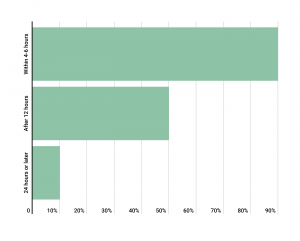
Equally you can run across from the chart above, if testicular torsion is treated within half-dozen hours, there's a 90 percentage gamble the testicle can be saved. Afterwards 24 hours, that rate drops to only x percent.
Subarachnoid hemorrhages are as well known equally bleeding on the brain, and have several causes, including concussions and traumatic brain injuries. This condition can also be deadly if not caught in fourth dimension.
Septicemia, also known as blood poisoning, occurs when leaner enters the bloodstream.
If you think you're suffering from any of these health issues, merely y'all tin can't detect a health care provider to accept you lot seriously, keep pushing until someone does the necessary testing to rule out or confirm any potential issues. It simply may be your life on the line.
Billing Errors
Billing errors happen when patients are charged for procedures they did not receive, or are charged for staying longer at an in-patient facility than they actually did, or correct procedures/stays accept been coded incorrectly due to information entry errors.
In fact, medical billing errors cost Americans around $210 billion annually.
Most medical bills, around 80 per centum of them, contain some type of error, and the errors are rarely in favor of the patient. Co-ordinate to ane report, there are around seventy,000 diagnosis codes that could be used, and around 71,000 process codes available. That makes errors most inevitable.
Medication Errors
Another major medical fault that affects public health in the United States is wrong medications or dosages of those medications. It costs over $40 billion per year to care for and treat patients who were victims of medication errors.
In the U.s., between 7,000 and 9,000 patients die from medication errors every year.
The types of errors that fall under this category include:
- Prescribing the incorrect medication.
- Declining to include a necessary part of the prescription.
- Telling the patient to take the prescription at the incorrect time of mean solar day.
- Giving the improper dose of medication.
- Failing to check whether the patient is allergic to that medication.
- Failing to cheque whether there are other medications the patient takes that could interact with the prescribed drug.
- Transcribing the prescription incorrectly.
In hospitals or outpatient facilities performing surgical procedures, this tin can also include anesthesia errors—either using as well much or too little, or using an anesthetic the patient is allergic to.
Patient Misidentification
Believe it or not, incorrect identification of patients occurs frequently enough to make this list. You may think it wouldn't be possible to misfile which patient is having which process performed, or even which patient the medico is there to see, just information technology happens.
In the nautical chart beneath, we examine a few instances related to frequency of misidentification.
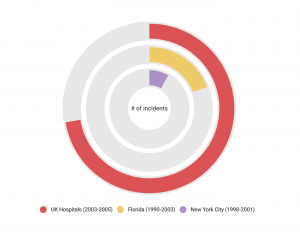
Between 2003 and 2005, hospitals in the United kingdom of great britain and northern ireland reported 236 incidents or near-incidents in which patients were misidentified.
Florida practitioners indicated that between 1990 and 2003, the wrong patient had gotten surgical procedures in 67 cases.
And in New York City, over a three-year span, the wrong patient had gotten an invasive medical procedure in 27 cases.
In ane incident from Boston, a patient with healthy kidneys was mistaken for a patient with a kidney tumor. The salubrious patient's kidney was removed—and the error was only discovered after the surgery had been performed.
The following graphic provides summary numbers from several misidentification incidents across the United States.
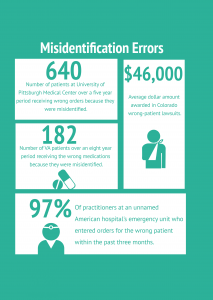
Information technology's difficult to know exactly how many cases of misidentification occur nationwide, but most researchers believe actual instances are much higher than reported numbers, and the impact on the afflicted individuals is enormous.
Surgical Errors
Finally, we have a look at surgical errors. According to data from 2012, surgical errors resulted in $1.3 billion in medical malpractice payouts annually. The annual number of surgical errors rose to a higher place 4,000, and were nigh all preventable.
In fact the authors of the study this data is based on called the surgical errors "never events," which means the errors never should have happened in the first place. These include things like leaving a surgical tool within the patient, or operating on the wrong limb.
The graphic below goes into more detail on mutual surgical errors and their frequency.
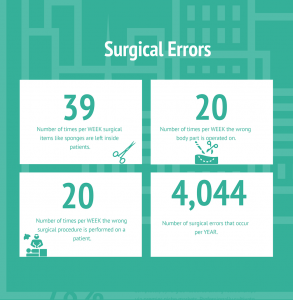
Are these surgical errors harmful, though? Co-ordinate to the data below—yes!
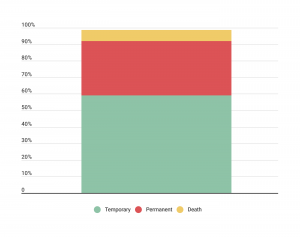
While the bulk of surgical errors simply resulted in temporary injuries (59 per centum), near 40 percent of these errors resulted in permanent injuries or decease. Less than ii percent of surgical errors resulted in no injury.
And near of the surgeons who committed surgical errors (two-thirds) had been involved in at to the lowest degree two prior medical malpractice actions.
What Causes Medical Errors?
What are the factors that go into creating a medical error, and are they fixable? Can we reduce the number of medical errors, and more importantly, the adverse furnishings of these errors on patients?
Nosotros review a few of the almost typical components that, in combination or alone, cause the vast majority of medical errors in the U.s..
- Lack of training
- Assigning tasks to inappropriate staff
- Rare or copy-cat illnesses
- Lack of adequate testing
- Fourth dimension-sensitivity—the treatment or procedure must be washed immediately
- Complexity of the illness or wellness result being treated
- Historic period of the patient
- New procedures
Let'southward look a little more closely at each of the factors listed higher up.
Training
In some cases, errors are caused by new staff, who are still learning or haven't encountered a specific state of affairs before, and therefore haven't had the necessary training to know how to handle the upshot presented.
Inappropriate Assignments
Other times, errors are due to assigning tasks to the incorrect staff. For example, i study constitute that pharmacy technicians were making medical formulations instead of the pharmacists, who were specially trained and educated for that purpose.
Rare Illness
Sometimes, a patient may have a rare affliction. Because these illnesses are rare, they're often misdiagnosed as something else, especially if their symptoms mimic another, much better known disease or illness. For example, meningitis and the influenza accept virtually identical symptoms.
Testing
Unfortunately, a patient's pre-existing wellness status may limit the corporeality of diagnostic testing that's done to determine the cause of reported symptoms.
In some cases, eye attacks in female patients may be dismissed equally simply an extreme panic assault, because the centre assail symptoms women experience are almost identical to those of panic attacks, and farther testing may not be washed.
Lack of adequate testing as well affects obese patients, equally it was establish that not all necessary diagnostic testing was washed for these patients, leading to diagnostic errors or failure to diagnose any illness or affliction at all.
Patients with pre-existing mental wellness disorders were especially vulnerable to this. For case, if a patient with depression reports a sudden lack of energy, they may be prescribed a higher dose of their antidepressant, instead of being tested for thyroid function or other possible culprits.
Fourth dimension Pressure
And whatsoever time there is pressure to go a diagnosis completed right abroad, or a procedure done immediately, at that place is a greater chance of missing the actual cause of the symptoms or performing the procedure incorrectly. (Or performing the wrong procedure.)
Complication
The more than complex an illness or disease is, or the more than circuitous the handling protocol required to assistance the patient, the college the risk that something will get missed along the way.
Age
Patients at both the high and depression ends of the historic period spectrum are ofttimes victims of medical errors, too. The youngest members of the population can't articulate their symptoms or what has been helpful in alleviating those symptoms, and that is often the same for the oldest members of the population.
New Procedures
Finally, if a new process is developed for the treatment of a disease or illness, there is always a learning bend related to putting that new procedure successfully into do. Sometimes a health care provider picks upwardly the new process quickly; but if they don't, medical errors may occur.
How Tin can Y'all Protect Yourself?
At this point, you may exist wondering how you lot tin can protect yourself and your loved ones from these types of errors. There are several things you can do, so take heart. All of these factors will contribute to your well-beingness.
- Ask questions at every phase. When seeking a diagnosis, ask your doctor nearly specific tests yous'd similar to have washed, or about specific health concerns you accept. If you lot're scheduled for surgery, inquire questions nearly the specific procedure, or almost whatsoever medications y'all may be prescribed.
- Go a second stance. While it may feel awkward or like you're betraying your medico'south trust in some way, it's in your best interests to get a 2d opinion when it comes to difficult diagnoses or major handling options.
- Do your homework. Research your condition and the appropriate treatment options every bit much every bit possible before whatsoever surgery or medications accept been prescribed. The better informed you are, the easier it volition exist to make up one's mind if your handling plan is correct and the best option for your situation.
- Request an itemized bill. This mode you can check dates of service, services provided, and the doctors involved in your treatment and/or diagnosis. Any medical mistakes will exist much easier to identify than if y'all receive a summarized argument.
- Bring someone with y'all. Ii heads are better than one! It'due south nervus-wracking to be in a dr.'s office or hospital and having someone y'all trust at your side tin make information technology easier to enquire questions and share pertinent information.
National Academy of Medicine
The National University of Medicine, formerly known as the Found of Medicine, is a non-profit organization that was originally created to provide leadership in the field of healthcare.
Two of their publications, Crossing the Quality Chasm (2001) and To Err is Human: Building a Safer Wellness Organisation (1999) shone a light on medical errors at the get-go of the 21st Century and garnered national attention.
Today, they continue to upshot publications related to the state of America's health care system, as well as examining health intendance problems world-wide.
Where Can I Acquire More?
To go more data on specific health weather, the Mayo Clinic's website has a "condition finder" where y'all can type in any status and come across what data they accept on it. You can as well look through an A-Z directory of conditions.
The Centers for Illness Command and Prevention also lists multiple weather condition, research being washed, and the latest treatments for certain diseases.
Condition-specific organizations, such as the American Heart Clan, are groovy options for getting more information on a specific condition you may exist concerned about.
The Bureau for Health Care Research and Quality's website has resources to assist patients abet for themselves and includes things patients tin do to help forbid medical errors, such as asking hospital staff if they've washed their hands before they bear upon anything that will impact you (needles, catheters, food trays, your pare).
You lot can always report a doctor or surgeon to your land's medical board if you lot have concerns most how they have handled your condition.
In Summary…
Getting proper medical care is necessary for your wellness and safety. While none of us want to believe that medical errors will happen to us, based on the frequency of these issues, information technology's highly probable that yous will feel at least 1 of the errors outlined here during your lifetime.
Educate yourself and your loved ones as well as you can on your specific health issues or wellness concerns, and don't be agape to push dorsum if something doesn't seem right. That persistence might only save your life.
Sources
- CNBC, "The Third-Leading Crusade of Death in U.S. About Doctors Don't Want You to Know About."
- The National Center for Biotechnology Information, "Medical Error."
- Johns Hopkins Medicine, "Study Suggests Medical Errors Now Third Leading Cause of Death in the U.S."
- Agency for Healthcare Research and Quality, "20 Tips to Help Prevent Medical Errors Patient Fact Sail."
- Centers for Illness Command and Prevention, "FastStats: Leading Causes of Decease."
- MedicalNewsToday, "i in 20 American Adults 'Misdiagnosed in Outpatient Clinics Each Year'."
- MedicineNet, "Definition of Cerebrovascular Accident."
- Wikipedia, "Myocardial Infarction."
- Medline Plus, "Epidural Abscess."
- The National Center for Biotechnology Information, "Spinal Epidural Abscess: Common Symptoms of an Emergency Condition."
- Mayo Clinic, "Pulmonary Embolism."
- The Centers for Affliction Command and Prevention, "Necrotizing Fasciitis: All You Need to Know."
- Mayo Dispensary, "Meningitis."
- TeensHealth from Nemours, "Testicular Torsion."
- Mayfield Encephalon & Spine, "Subarachnoid Hemorrhage and Vasospasm."
- Healthline, "Septicemia."
- Anxiety and Depression Association of America, "Am I Having a Panic Attack or a Heart Attack?"
- Healthline, "Upwards to eighty% of Hospital Bills Have Errors. Are You Existence Overcharged?"
- Becker Hospital Review, "Medical Billing Errors Growing, Says Medical Billing Advocates of America."
- The National Center for Biotechnology Information, "Medication Errors."
- Agency for Healthcare Inquiry and Quality, "Mistaken Identity."
- ECRI Institute, "Patient Identification Errors."
- JAMA Network, "Wrong-Site and Wrong-Patient Procedures in the Universal Protocol Era."
- Boston Globe, "14 Instances of Right Procedure, Wrong Patient in Mass."
- WebMD, "Thousands of Mistakes Made in Surgery Every Year."
- National Academy of Medicine, "To Err is Human: Building a Safer Health System."
- National Academy of Medicine, "Crossing the Quality Chasm: A New Health Organization for the 21st Century."
Note: also checkout our statistics on rare diseases.
Source: https://mymedicalscore.com/medical-error-statistics/
Postar um comentário for "Do You Want Report Medical Errors to Family"