Why Did We Ned the Family and Medical Leave Act 1993
The Family and Medical Exit Act at twenty: Still Necessary, All the same Not Enough
Ii decades agone, President Pecker Clinton signed the FMLA. It remains the only slice of legislation aimed at helping to manage the piece of work-life balance.
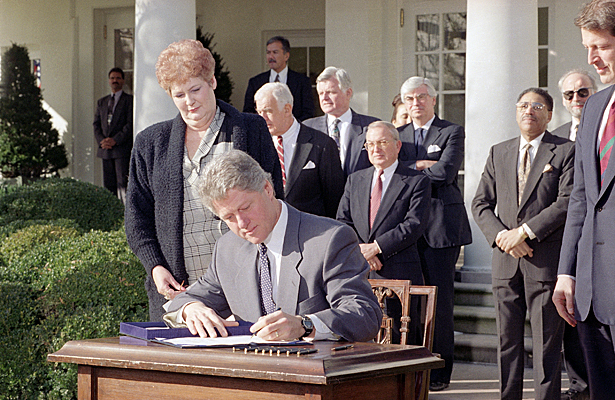
Pres. Clinton signs the Family Leave Bill in the Rose Garden of the White House on February. v, 1993. (Greg Gibson/AP Images)
Twenty years ago today, on February 5, 1993, one-time President Bill Clinton signed his starting time neb into law: the Family and Medical Get out Act. The Family unit and Medical Get out Human action, too known as FMLA, allows up to 12 weeks of unpaid, job-protected leave to workers in society to recover from a serious medical condition, provide treat a seriously sick family member, or care for a new child. The FMLA remains to this day the but piece of federal legislation specifically focused on helping workers manage their dual responsibilities in the workplace and in the home.
Information technology was no blow that this was the showtime piece of legislation Clinton signed, as presidents oftentimes use the first bill they sign into law as a way to convey a message well-nigh their priorities and what kind of leader they will exist. President George West. Bush signaled his conservative roots by first signing Business firm Joint Resolution 7, which honored the 90th birthday of former President Ronald Reagan. President Barack Obama'due south first signing was of the Lilly Ledbetter Fair Pay Human action, which extended the statute of limitations for pay equity lawsuits, and signaled his back up for the women voters who were then crucial in his election.
Back in 1993 when Clinton took office, it was already clear that our families were changing. Signing the Family and Medical Exit Human activity showed recognition of this new reality. At the time more than than half of mothers were either the breadwinner for their families or shared that responsibility with a partner—which has only increased in the decades since. Long gone were the days when most families had a full-fourth dimension, stay-calm caregiver, and the government responded with a new policy to reflect that fact.
Related Story

Merely the policy battle was non hands won. The fight for the FMLA had started nearly a decade before, and congenital upon the legacy of state level family unit leave legislation. It was initially drafted while President Reagan was still in part, and passed through Congress simply was vetoed by quondam president George H.West. Bush before Clinton came into role and signed it into law (notably, his son George W. Bush likewise vetoed an expansion of the FMLA to provide upwardly to 26 weeks of unpaid go out to workers who are caring for a wounded service member in active duty, which was later signed into law by President Obama.)
Despite the struggles to run into it enacted, the Family unit and Medical Exit Human action and has been shown to cause employers, by their own account, little to no problems even after having been used past workers more than 100 million times. And while the FMLA was, and is, vitally important for workers, the fact that we have seen no boosted progress in piece of work-life legislation over the last two decades, in spite of lagging behind the residual of the world in this regard, is an embarrassment at best.
No 1 should underestimate the positive impact that the Family and Medical Leave Act has had on workers' lives. While the go out is unpaid, information technology does provide job protection and the extension of health insurance benefits for workers while they are unable to work. Prior to its passage, if a worker had a middle attack, or needed fourth dimension off to take their spouse to chemotherapy appointments, or to provide care to a newborn or newly adopted kid, at that place was nil to guarantee that they would not exist fired. And considering the fact that almost FMLA leave is taken to recover from a serious illness or accident, or to care for an sick or injured family fellow member, holding on to employer provided wellness insurance is clearly important.
Merely the Family and Medical Get out Human action is non perfect, nor does it address all of the needs workers have. Because it is unpaid many workers cannot beget to take the exit even when they need to - in fact, nearly one-half of those who qualified for the leave but did not take it said that was due to fiscal reasons. And near 4-in-10 workers practise not qualify for FMLA leave in the first place, since it is restricted to workers who have been employed at their electric current job for at least a year, have worked a minimum of 1,250 hours in the 12 months before their leave is to brainstorm, and who piece of work for an employer with at least 50 employees within a 75-mile radius.
The other half of workers who are not covered by the Family and Medical Leave Human action may exist able to cobble together some complicated affiliation of earned sick days or vacation time, but fifty-fifty access to those benefits are not guaranteed past constabulary. According to data collected by the Bureau of Labor Statistics equally role of the American Time Use Survey, 36 percent of American workers over the age of xviii do not have access to whatsoever course of paid exit at all—not paid ill exit, not paid parental leave, non paid vacation. The U.s.a. remains the but industrialized nation that does non offer paid maternity get out, in addition to existence the but advanced economy that does not guarantee the right to earned ill days. This is why the Center for American Progress has proposed Social Security Cares, a national paid family unit and medical go out insurance program that would embrace the same life events that are covered under the FMLA and offering partial wage replacement that was funded through a pocket-size (less than one-half of i-percent) increase in the payroll tax.
When old President Clinton signed the Family and Medical Go out Act in 1993 he acknowledged the manner that our families and workplaces have inverse and the need for common sense work-family unit policies so that no ane has to cull between being a good worker and a good family unit fellow member. Unfortunately progress has stalled in the two decades since. Hopefully President Barack Obama'south 2d term will showtime united states moving once more in the correct management.
Source: https://www.theatlantic.com/sexes/archive/2013/02/the-family-and-medical-leave-act-at-20-still-necessary-still-not-enough/272605/

Postar um comentário for "Why Did We Ned the Family and Medical Leave Act 1993"