what is the difference between buddhism and punctualism, according to mark siderits?
Your gratuitous articles
You've read 1 of your four complimentary articles for this month.
Yous can read four articles free per month. To have complete access to the thousands of philosophy articles on this site, please
The Cocky
Is The Buddhist 'No-Cocky' Doctrine Compatible With Pursuing Nirvana?
Katie Javanaud asks whether there is a contradiction at the middle of Buddhism.
Two of the nigh fundamental doctrines of Buddhism are firstly that the self is illusory, and secondly that we can achieve liberation from the cycle of death and rebirth to reach a state of peace called Nirvana. From the perspective of Western philosophy, it may announced inconsistent to merits both that there is no cocky and that Nirvana can withal exist attained, for who or what attains liberation if at that place is no cocky in need of liberation?
Although this is a common objection to Buddhism, to consider its validity we must explore the concept of Nirvana more fully in order to empathise the liberation it offers. We will also need to examine the notion that there is no self, a notion which is inherently hard to have, just has been held by a number of philosophers, notably David Hume. The doctrine is certainly asserted past Buddhism, and was strongly implied past sermons of the Buddha himself (run across poetry 7 of the Dhammapada, or the Alagaddupama-Sutta of the Majjhima Nikaya).
When examining the compatibility between the Buddhist claims of 'no-cocky' and the Buddhist project of liberation, the pursuit of Nirvana, as we will exercise in this commodity, we volition accept to remember that many profound thinkers have establish a fashion to hold the 2 doctrines simultaneously. Even so, every bit we shall come across, one difficulty with this opinion is that it seems to crave those who hold it to abandon the demands of reason for a position which is defended without recourse to the usual methods of philosophical inquiry.
What would result from the discovery of either the compatibility or the incompatibility of the 2 doctrines? Even if nosotros discover that the Nirvana/no-self combination lacks cogency, does it follow that the theory of no-self is no longer valuable – for that theory supports the doctrine of not-attachment, which grounds the Buddhist ethic of universal pity? Alternatively, if we discover that Buddhists tin can hold the two claims simultaneously without contradiction, this in itself neither shows that the 'no-self' doctrine is actually true, nor that the lay person would be compelled to take that the self is an illusion.
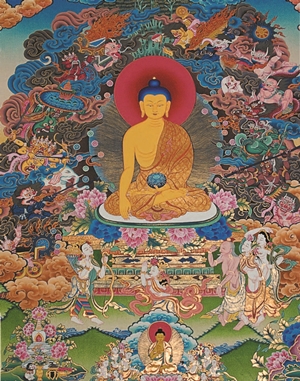
According to Buddhism, the central characteristics of existence are impermanence, suffering and 'no-self'. The Buddha'due south view of life equally suffering might requite ascent to the notion that Buddhism is essentially pessimistic. Withal, every bit I argue, in offer a complete liberation from suffering, Buddhism is highly optimistic. Understanding that the cause of suffering is craving (the Buddha's 2nd Noble Truth) enables us to eradicate suffering by removing the cause – which is accomplished by following the Eightfold Path in order to be freed from the cycle of re-birth and the accumulation of karma. To attain liberation from the cycle of re-nascence and the accumulation of karma, among other things, one must relinquish the belief in an enduring self retaining identity over time and performing the executive function of 'controller'. Abandoning a belief in an indelible self is a natural step for any Buddhist paying close attention to the abiding flux occurring in the globe. So our starting point will exist an exam of the 'no-cocky' doctrine. We will then examine various definitions of liberation, attempting to construct a definition that renders this liberation uniform with 'no-cocky'. I shall in fact offer two answers to the title question; which one we take volition depend on our attitude towards the claims of logic. For textual sources, I volition focus primarily on the Abhidharma forms of Buddhism, as it is impossible hither to cover all branches/schools of Buddhism.
The Self That Buddhism Denies
What is the nature of the self that Buddhists deny, and how can they justify this claim?
It is necessary firstly to sympathize the Buddhist distinction between 'persons' and 'the self', which is legitimised by differentiating between conventional and ultimate truths:
"A statement is conventionally true if and only if information technology is adequate to mutual sense and consistently leads to successful practise… A statement is ultimately truthful if and only if it corresponds to the facts and neither asserts nor presupposes the existence of whatever conceptual fictions."
(Mark Siderits, Buddhism as Philosophy, 2007)
Buddhists argue that it is just conventionally, not ultimately, true that we are persons: that is, our conception of ourselves as persons does not represent with reality. As it says in the Mahayana-Sutralankara, "A person should be mentioned as existing only in designation… just not in reality [or substance, dravya]." Buddhists say that we consider ourselves persons because, through experience, we larn that we are constituted of 5 skandhas or aspects: trunk (rupa), feelings (vedana), perceptions (samjna), volitions (samskaras), and consciousness (vijnana). But the word 'person' becomes only a user-friendly designator for the fiction we accept when nosotros believe that a 'person' is something over and above these component parts. Buddhists therefore accept what Buddhism scholar Mark Siderits calls a 'mereological reductionism' nearly persons: they claim that the parts be, just the supposed whole does not.
This position is discussed in the Milindapanha or Questions of Rex Milinda (c. 100 BCE). Milinda is shocked to hear the monk Nagasena deny the being of a self, and asks whether each of the bodily parts of Nagasena and and then each of his mental constituents constitute his cocky. To each question Nagasena replies negatively. Initially this leads Milinda to view the term 'Nagasena' as an 'empty sound' – even a lie. Nagasena so scrutinises Milinda's claim that he arrived by chariot in the same terms, request whether 'chariot' refers to the beam, pole, seat etc., or whether 'chariot' refers simply to the unity of these parts. To each of these Milinda as well replies negatively. During this interrogation Milinda'due south view of the self as a 'convenient designator' or 'conceptual fiction' is transformed from the idea of information technology being a mere 'empty sound' into his understanding that the term 'chariot' or 'Nagasena' or any other composite entity "is but a mode of counting, term, appellation, convenient designation, mere proper noun…" He acknowledges that the belief is conventionally truthful, but of persons "in the absolute sense there is no ego… to exist institute" (Radhakrishnan & Moore, A Sourcebook in Indian Philosophy, p.284).
When Buddhists affirm the doctrine of 'no-self', they accept a clear formulation of what a cocky would be. The self Buddhists deny would have to meet the following criteria: information technology would (i) retain identity over time, (ii) be permanent (that is, enduring), and (iii) have 'controlling powers' over the parts of a person. Yet through empirical investigation, Buddhists conclude that at that place is no such matter. 'I' is commonly used to refer to the mind/body integration of the five skandhas, merely when we examine these, nosotros discover that in none alone are the necessary criteria for self met, and as nosotros've seen, the combination of them is a convenient fiction. So, could there be something exterior the skandhas that constitutes the cocky? Siderits observes: "in order for the Buddha's strategy to work, he will have to show that the doctrine of the 5 skandhas gives an exhaustive analysis of the parts of the person" (Buddhism as Philosophy, p.37). This exhaustiveness claim amounts to asserting that every element or aspect of a person is accounted for by the five skandhas.
Objectors to the exhaustiveness claim often argue that for discovering the self the Buddhist commitment to empirical means is mistaken. Truthful, we cannot discover the self in the five skandhas, precisely because the self is that which is across or distinct from the five skandhas. Whereas Buddhists deny the self on grounds that, if it were in that location, we would be able to point it out, opponents of this view, including Sankara of the Hindu Advaita Vedanta schoolhouse, are non at all surprised that nosotros cannot point out the self; for the cocky is that which does the pointing rather than that which is pointed at. Buddha dedicated his commitment to the empirical method on grounds that, without it, one abandons the pursuit of knowledge in favour of speculation. In the Alagaddupama-Sutta (= 'Snake Simile Discourse'), Buddha says "O monks, when neither self nor annihilation pertaining to self tin can truly and really be plant, this speculative view 'The universe is that Atman (Soul); I shall exist that after expiry, permanent, constant, always-lasting, unchanging and I shall exist equally such for eternity', is it not wholly and completely foolish?" (W.S. Rahula, What The Buddha Taught, p58).
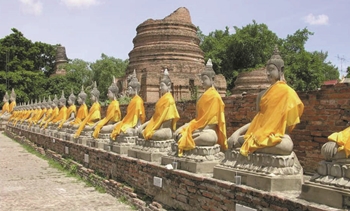
Aboriginal Buddhist site of Ayutthaya in Thailand
The Argument from Impermanence
Buddhism presents two further arguments for the doctrine of 'no-self': the statement from impermanence and the argument from control. The statement from impermanence relies on the exhaustiveness merits, whose validity is implicit in the premises of the statement. The statement can be summarized thus:
ane. The five skandhas are impermanent.
two. If there was a cocky, information technology would exist permanent.
3. A person is no more than the five skandhas (this is the exhaustiveness claim).
4. Therefore in that location is no self.
This argument is logically audio. However, the truth of the conclusion depends on premise three. Could at that place be something transcending the five skandhas which should exist recognized as a self?
Sarvepalli Radhakrishnan, a follower of the Hindu school of Advaita-Vedanta, thinks that there must be. More controversially, he argues that the Buddha besides idea at that place must be some self beyond the v skandhas. Radhakrishnan (an Oxford philosopher and later President of India) appeals to Udana eight.3, where the Buddha states, "There is an unborn, an unoriginated, an unmade, an uncompounded; were there non… there would be no escape from the world of the born, the originated, the fabricated and the compounded" (S. Radhakrishnan, Indian Philosophy Vol.1, p.320). However, what Buddha meant past his assertions virtually the 'unborn' in Udana 8.3 is unclear. There are at to the lowest degree two possible interpretations: (i) To assert that 'x' is unborn is to say that information technology does non come into existence at a particular fourth dimension because information technology never has a beginning, i.e., it is eternal. In this case, being 'unborn' would be predicated of some eternal entity; (two) Alternatively to posit that 'x' is 'unborn' may exist to assert the absence of '10's' nativity i.eastward. it is not-built-in. On this interpretation we would just be denying the beingness of the entity in question, saying either that the being in question had non been built-in nonetheless or that information technology never would be built-in (although in either case, specially the latter, it would not make much sense to refer to it as a being). Given the divergent interpretations of the Buddha's meaning of 'unborn' here, we cannot presume that the Buddha intended to posit an eternal entity which is 'unborn' in the outset sense. Instead, and more than in keeping with the remainder of Buddhist thought, Udana 8.3 could be an expression of the absence of an eternal entity. And then, when Buddha says there is an 'unborn' rather than an eternal changeless entity, he could but be asserting that there is no such entity. And even if Buddha is asserting the existence of some unoriginated entity, why should we designate this entity as the self? What Buddhism is precisely denying is that the entity we commonly call 'self' meets the criteria for selfhood (namely permanence, control and numerical identity over time).
The idea of permanence is closely related to that of numerical identity. Buddhists deny that a person can remain numerically identical with him or herself over fourth dimension on that grounds that time itself necessarily implies numerical change. This 'doctrine of momentariness' entails that at every moment, the five skandhas arise, are destroyed and are succeeded past other numerically distinct (if similar) skandhas. Indeed, ascertainment of mental states does reveal that our feelings, volitions and objects of consciousness are constantly irresolute.
The Statement from Control
On the conventional view of a person as accepted in mutual soapbox, we believe nosotros tin can alter aspects of ourselves, and that information technology is 'we' who practice this. If there is an aspect of our cocky which dissatisfies united states of america, we effort to change it. This concept presupposes that the self is the type of thing that can perform a controlling function on parts of the person. However, the executive functioning of the self is undermined past the Principle of Irreflexivity, which asserts that an entity cannot operate upon itself. The truth of this principle is established by observation, in keeping with Buddhist empiricism. To back up the claim, Buddhists appeal to the post-obit evidence: a knife cannot cut itself, a finger cannot point to itself, etc. It follows that "if the cocky performed the executive function, information technology could perform that role on other parts of the person, but non on itself. This means that I could never find myself dissatisfied with and wanting to change myself, which in plough ways that any part of me that I can find myself wanting to change could not be myself" (Buddhism as Philosophy, p.47).
Sankara'due south principle of consciousness bears some of the same properties (such as numerical identity over time and permanence) as the self which Buddhists deny. Different the Buddhist notion of cocky, however, the Advaita Vedanta school does not say the cocky would exist a controller or performer of executive functions, only an experiencer of perceptions and thoughts. According to Sankara, the cocky is a universal transcendental entity unconnected with the concrete world of appearances. In both philosophical systems the question of the relationship betwixt this somewhat abstruse self and the individual one takes as oneself arises, for the 'transcendental' and 'experiential' self do not seem identical. Consequently, when we talk of the self which the Buddhist denies simply other schools accept, we are not talking of persons or individuals in their usual senses.
In characterizing what a cocky would be if it were instantiated, Buddhists have claimed three main properties: permanence, command and numerical identity. We take looked at two arguments advancing the no-self doctrine, which draw on the idea of a self as permanent or controlling respectively. These arguments provide some support for the doctrine of no-self. However, our initial protest against the doctrine remains. Cognition, suffering, rebirth (all primal Buddhist ideas), arise only if we can presume the existence of a field of study to whom these things apply. For case, our ability to analyse the arguments for 'no-self', and our acknowledging that the skandhas are in a constant land of arising and dissolving, presupposes that in that location is a self which has the capacity to analyse and to observe change. This leads united states of america again to ask: how can the concept of liberation remain coherent unless we can identify one who is liberated? Would it exist philosophically justifiable to have the Buddha'southward suggestion that these problems are non in need of urgent accost?
The Concept of Nirvana
The definition of Nirvana is crucial to determining whether the no-cocky doctrine and the Buddhist project of liberation are compatible. 'Nirvana' is literally translated from the Sanskrit as 'extinction/snuffed out'. This liberation from continual rebirth and suffering is the issue of enlightenment, which occurs when our ignorance well-nigh the nature of existence and the false belief in a cocky is eradicated. It is important to qualify that what is extinguished is suffering (ultimately acquired by ignorance): the self is non extinguished, for at that place never was a self, just the illusion of one.
If we define Nirvana in negative terms, as annihilation, extinction or nothingness, so since true nothingness plausibly implies that nobody experiences it, the Buddhists could plausibly affirm the compatibility of 'no-self' with this concept of liberation. Even so, if we practise characterise Nirvana as pettiness, there are at least two different things we could mean by this, and both are questionable. If by nothingness we hateful an absolute void, and then although this may be compatible with the doctrine of no-self, the question arises as to whether nosotros could rightly draw this as 'liberation'. Rather, this definition of Nirvana forces the conclusion that Buddhism is essentially nihilistic – which Buddhists would deny. Alternatively, nosotros could interpret the 'pettiness' of Nirvana to hateful an 'undifferentiated continuum'. This definition besides has its difficulties: could we be describing nothingness if we are providing an idea of what it is like? Wouldn't this be a refutation of its actual nothingness? And again, in what sense would this be 'liberation'? It remains the case that the notion of liberation is meaningful simply if we can place who is liberated. Alternatively, nosotros could narrate Nirvana in positive terms, describing it as a blissful state – although once over again, this would seem to necessitate a self for whom information technology is beatific.
Buddha himself said little about the state of beings who attain liberation, or what happens to them later death. In a dialogue with his disciple Vaccha, Buddha says of the Aware Ane: "to say that he is reborn would not fit the example… to say that he is not reborn would not fit the case… to say that he is both reborn and not reborn would non fit the case… to say that he is neither reborn nor not reborn would not fit the example" (A Sourcebook in Indian Philosophy, p.290). The tetralemma indicates that when we ask what the state of liberation is similar for the i who has attained information technology, the question has been misconceived.
Although logically it must exist the case that the Enlightened One is either reborn or not reborn (either continues to experience subsequently death or does non), Buddha is here asserting that none of the iv possibilities are actualized. What this suggests is that to define Nirvana in either negative or positive terms is to misunderstand it, limiting it co-ordinate to our present state of ignorance. As Siderits writes, "Since logic suggests that one of the four possibilities would have to be truthful, the conclusion seems inescapable that the Buddha is calling Nirvana something that transcends all rational discourse" (Buddhism as Philosophy, p.72). Nirvana could be that which transcends all normal human being experience (and for the Buddhist must necessarily exercise and so, since normal human existence entails suffering and is characterized by 'becoming'). To endeavor to speak rationally of the status of those who achieve Nirvana, or about the nature of Nirvana itself, is to misunderstand the topic nether discussion: Nirvana is ineffable. As D.T. Suzuki, an adherent of Zen Buddhism, puts information technology: "As long as we stay at the level of relativity or intellectualization, we shall have all kinds of disagreement and have to keep up a serial of hot discussions" (The Field of Zen, p.36); and as long as Buddhism "appeals to linguistic communication to express itself, it inevitably becomes the victim of all the inconveniences, all the restrictions, and all the contradictions which are inherent in language" (p.28). Notwithstanding equally radically 'other' from anything we experience, Nirvana is in a category of its ain. However, from this formulation of Nirvana, it is incommunicable to decide whether information technology is logically compatible with the doctrine of no-self.
Appeals to the ineffable quality of Nirvana may exist legitimate, since Buddhism defines Nirvana as that which is radically different from anything which we now feel. But given that the Buddha made quite scathing remarks well-nigh the foolishness of speculation non based on experience, how can we talk about the nature of liberation? As A.One thousand. Warder correctly observes of Buddhist methodology "What was showtime picked up as a slice of data volition non be fully understood until the trainee sees the truth himself through his own experience. He must not just believe it, he must verify it" (Indian Buddhism, p.102).
At that place are 2 other major problems with experience here: (i) If experience is suffering, how could the feel of enlightenment result in liberation? (ii) A central cause of suffering, co-ordinate to Buddhism, is psychological zipper to the cocky. This is one of the master hindrances to liberation; and yet in the very process of relinquishing this attachment, in order to attain it i must personally experience liberation. This seems to be putting the cart before the horse, just immediately afterwards to put the horse back in front of the cart. The paradox of liberation, meanwhile, trots on! Given these problems, we must be careful non just to appeal to mysticism, or to the 'ineffable' quality of Nirvana. Although from this side of liberation (that is, from our position of ignorance) it may exist tempting to speculate near Nirvana, doing so could itself exist a form of ignorance, and thus a bulwark to the very thing we seek. For perhaps Nirvana is nothing positive in its own correct, but simply a cessation of suffering and ignorance.
Conclusion
In conclusion, the best we tin offering by fashion of an reply to our title question is itself a question: does logic invariably reflect ultimate reality, or is it possible that the logically impossible could in fact exist instantiated? Would the logical incompatibility of the two doctrines of 'no-self' and self-liberation necessarily have to result in the falsehood of at least one of the doctrines? What Buddhists have attempted to practice in postulating Nirvana is "to clear away all obstacles – including reason itself – that stood in the way of the realization of the reality that transcended ordinary astounding existence… [Buddhists] rejected all reasons and positions non because [they are] pessimists or nihilists merely considering reality was inaccessible to reason and ordinary perception" (B.A. Elman, 'Nietzsche and Buddhism'; Journal of the History of Ideas, Vol.44, 1983, p.683). When Buddhists claim that Nirvana is blissful, they could be describing it every bit a positive state of pleasure or happiness, merely this interpretation is unwarranted given their delivery to the view that homo experience invariably brings with it existential angst and suffering. The culling nosotros are left with is that Nirvana is blissful in the sense that it is a land gratuitous from all pain and suffering, only it is otherwise not something about which we can speak meaningfully from this side of liberation. Maybe we may accept glimpses in our lifetime of what Nirvana is like, merely whenever nosotros endeavor to capture what it is, we immediately loose sight of it: Nirvana is by nature indescribable, and therefore we cannot make the concluding pronouncement on whether 'no-self' is compatible with it.
© Katie Javanaud 2013
Katie Javanaud has a degree in philosophy and theology from Oxford, and is studying for an MA in History of Philosophy at King'southward, London.
Source: https://philosophynow.org/issues/97/Is_The_Buddhist_No-Self_Doctrine_Compatible_With_Pursuing_Nirvana

Postar um comentário for "what is the difference between buddhism and punctualism, according to mark siderits?"